Alabaster’s Setting Writing
Descriptive narrative is a passion and a practice. Of all the talents I pride myself over, setting the scene is one I work on during every preparation and every session. With the tools available today we can offer a quick picture for our players. They can glance over the room, and then we are on to the next thing. My goal is to capture them in the room, not in a designed cage with chains or locks, but in having it flush with potential questions, additional observations, bits of lore hidden on bookshelves and in drawers. A feast for the eyes, ears, and imagination.
When it comes to preparation I prefer to not write a script, but take an image with many details on it. The image may be one I know well and have used before, it may be one fresh from one of the artists who poured hours into adding an amazing amount descriptive inspiration. The following is the start of processing an image for oration.
Getting Started: Setting Layer One
To begin, I describe all the big points in the room. The things catching my eye first when I look at it, writing them down to get the words all put together for myself.
The Office of Ulm Merci Anne
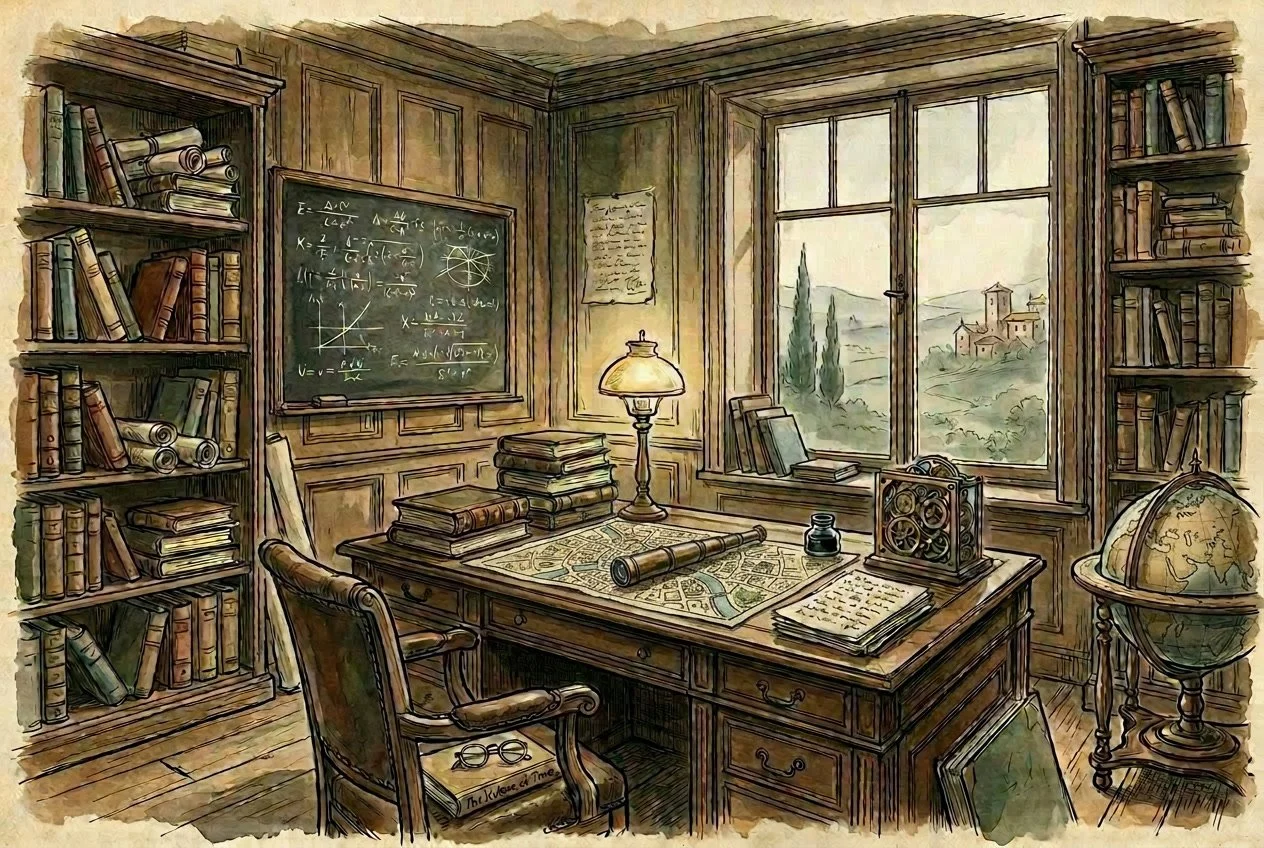
The room has a large window letting in plenty of light on the far wall from the door, outside the window, even from where you stand at the door, you can see the taller buildings of the villa over the trees. There are notes written on a chalkboard to the left of the window. In between the window and the chalkboard is a letter pinned up on the wall. There are four books on the window sill.
There are two bookshelves filled with tomes of many different subjects and from a quick count, seven scrolls. A few large posters lean on the left bookshelf underneath the chalkboard. A globe sitting on the floor on the right side of the room sits in front of the other bookshelf.
Everything surrounds an organized desk covered in a few books, an unfolded map, a spyglass, a strange piece of clockwork, a jar of ink, uncapped with its lid sitting next to it, a very nice pen, and a stack of pages. The desk is quite nice, featuring seven drawers. There is only one chair, it is wooden with leatherbound armrests and cushions. On the chair is a book with a pair of glasses sitting on top of it.
A large book sits propped on the side of the desk. The last thing you notice is the lamp in the middle of the room. It is turned on even though the daylight from outside is pouring in.
After writing out my general description, I’ll put the items into a bulleted list. The information tied to each line of the bulleted list is the Setting: Layer Two.
Notes on the chalkboard.
Letter on the Wall.
Four books on the window sill.
35 books on the left book shelf.
Another 41 books on the right book shelf.
7 Scrolls.
3 Large Posters
The Globe
7 books on the desk.
The map on the desk.
The spyglass.
Strange Clockwork Box.
The jar of ink and its lid.
The very nice pen.
The stack of pages on the desk.
7 Drawers of the desk.
The pair of glasses.
The book on the chair called “The Nature of Time.”
The large book leaning against the desk.
The Lit Lamp
Ulm Merci Anne
Terri Coless, City Planner
Magistrate Moores, Merci’s Assistant.
With any description of the objects in the room, I like to be prepared with deeper information. Any item on this list after giving this description, and posting the picture for the group may capture the interest of the players at the table. I either need to be ready to improvise the contents, or have the list in front of me. Generally, I have my lists ready.
Because I posted the image we took the time to write out, we have very few callbacks for information about our thorough disclosure of the room. The players can then find their focus points among those entries I put emphasis on or grazed over so quickly it must be something. Depending on the player.
Before I go on to detail my lists with bites of lore, I read through my longform for the room. Out loud. Sometimes in front of a mirror. Five to ten times, often only one or two sentences at a time. With both the image and the longform in hand. This does two big things for me. It makes the words I struggle on when reading out loud, at least for the passage, not come out with my usual hang-ups. It also helps me edit the passage for readability and sometimes I’ll stumble onto better, fancier, fantastical descriptions as I go along.
The last items are the Supporting Characters who may or may not be present who frequent the setting. I don’t always add extras, but if I have story lines, the extras will be written in the scene instead of as a frequent visitor.
Now, Not Every Story Guide…
Not every Story Guide needs to be as thorough as this, and you don’t have to for every scene. Really, the main highlights are what we want to be able to put on display. The office of a quest giver where players will often find her! Of course I will go at least two layers deep with everything in the room which catches my eye for the original longform. Going three layers is usually my limit, we’ll fill in on layer three after I do Setting: Layer Two here.
Setting: Layer Two - Obvious Object Information
Notes on the Chalkboard (1.)
There is a worked out pair of math problems. It is an adjustment to fire based elemental magic to prevent non-magical fires from starting due to the heat of the spells.
Letter on the Wall (2.)
Written in Onymi:
For Merci Anne.
There has not been a colleague I have found more worthy of taking on the logistical burdens of Northern Arendon. Myself and Graves both find you qualified and pass to you our authority over the district.
Signed, Gen. Porrim Ahday
Signed, Ulm Shorel Graves
Four Books - Window Sill (3.)
These books seem to be separated from the bookshelves. One is the auto-biography of Shorel Graves, titled, “Dead at Rest.” Another is called “Walking Through The Expanse.” The two others are, “Rail Maintenance,” and the last is an untitled journal with a small lock on its front.
35 Books on the shelf (4.) Another 41 Books (5.)
Handling a lot of book titles has always been a uht-oh. Looks lovely in the scene, but suggests a ton of information. In these two bookshelves are a grand total of 76 books. There is a world building possibility here. If I make a list of 100 book titles. I can reuse many of them over and over in the world. I could go so far as the draw up a thousand, but we do want some redundancy. Be careful with what books you choose to name off multiple times. Players will get curious about repeat titles. Here’s our list, it goes deep. Books of Ager Ethe
7 Scrolls (6.)
Using the Rune Scribed Scrolls list, I threw together the ones which would make sense for an office of a magistrate. Five of these are Contract Runscriptia and the other two are Archival Runscriptia.
3 Posters (7.)
If the group unfolds these large posters, they’ll find city planning models for new construction.
The Globe (8.)
This globe shows Ager Ethe and Oler Althe. If embedded into another setting, it’ll also have those continents.
7 Books on the Desk (9.)
More books! Good thing we have a nice list to pick from if our players go snooping.
The Map on the Desk (10.)
This map is of Northern Arendon.
The Spyglass (11.)
This spyglass is really well made and has the perspective enchantment. As you look through it and extend it, it has almost 1000 Tiles of Zoom. Once you have narrowed in on the location, you can twist the end of the spyglass and then turn in place to look around as if you were standing at the location yourself. It’s quite disorienting when you try it for the first time.
Strange Clockwork Box (12.)
This clockwork box seems to be a Horologist’s practice gear kit. It is missing the leaver which would spin it.
The Jar of Ink and its Lid (13.)
It almost looks irresponsible. The lid is laying haphazardly to the side of the jar. On closer inspection, the ink inside hasn’t dried yet.
A Very Nice Pen (14.)
This pen was hand crafted. You can see the imperfections which set it apart from a machined pen. Still, beautiful craftsmanship. If Merci is asked about it, she relays it was a gift from Graves when she took the office.
Stack of Papers (15.)
This stack of papers are all judgements and correspondence attached to grievances from Merci’s constituents from Northern Ardenhaven. Her handwriting is neat, and her offered solutions or rejections are simple and well rooted in the needs of the greater good.
7 Desk Drawers (16.)
Going through all the drawers you find two stacks 10 stacks of parchment, another 3 vials of ink. Two ledgers, “Northern Ardenhaven Utilities,” is a line spread of the city’s utility bills which have been paid, the other is “Acquisitions and Payouts,” Which details the properties, employees, and costs associated such as payroll and rent. One drawer has an extra set of clothes in it. Another drawer has toiletries. Soap, conditioner, and a towel.
A Pair of Reading Glasses (17.)
At first glance these glasses are simple reading glasses. If thoroughly inspected however, reveal they are Text Translation Glasses, allowing the wearer to read most languages when equipped, provided they are literate in Cirrus Standard.
The book on the chair called “The Nature of Time.” (18.)
The nature of time reveals the Ozwall Overzone Timescales. Though it reads in a science fiction kind of way, a reader could glean a real location of a gate from Renisans to Molthern.
The Large Book Leaning Against the Desk (19.)
This book is an Planning & Atlas of Renisans, showing slightly outdated overviews of Port Einier, Riverbend, and the Ardenhaven districts. It includes topography of neighborhoods, city blocks, and underground infrastructure.
The Lit Lamp (20.)
I’d say it is strange for this lamp to be lit. It doesn’t put off much heat, and the light doesn’t look like oil fire. Touching it causes it to turn off, and touching it again makes it turn back on.
Frequent Supporting Characters
Ulm Merci Anne (21.) • Terri Coless, City Planner (22.) • Magistrate Moores, Merci’s Assistant (23.)
Setting: Layer Three - Inspiring Information
Layer Three information is by hopeful design, leading the players towards a new objective. It is actionable information. The info may be a way to contact a Supporting Character, or an Address. A key which includes what lock it goes to, or a lock mentioned previously where the player can tie the information together.
For the picture we have here, the two obvious places to ruffle through for more includes the bookshelves and the desk. Well, these are the obvious places to me. For Layer Three, the process is more table specific. With my newer players, their characters tend to be closer to the cookie cutter. My advanced players are often breaking the tools they have, they’ve swapped the spices on the meat in character creation.
As I am working on my deeper tones I make reference of the characters histories, my notes on their actions and motivations, and check the activity. If one player has been at the back of the group for a while I’ll do what I can to pick out stories which will help them shine in the moments.
With these sets of information in hand, I’ll add a list of bites for the players. At this point though, my ability to improvise is the challenge. With so much preparation, I can use this location over and over again.